
Dealing with Job Ghosting: Proactive Steps for Tech Professionals
By Patryk Domasik · Created with AI assistance
Waiting for an employer's response can leave you unsure whether to follow up, keep waiting or move on. A missed reply does not reveal why communication stopped. Use the information you have, send a measured check-in when appropriate, and keep the rest of your search moving.
Start with the last agreed next step
Check the original application, your last email and your interview notes. Did the employer promise a response date? Did they ask candidates not to follow up? Is there a recruiter who has already been communicating with you?
If the stated timeline has not passed, use that as your reference. If no timeline was given, choose a reasonable check-in date based on the stage and prior conversation. There is no universal number of days that guarantees a useful response.
Decide what kind of follow-up is appropriate
| Situation | A practical next step |
|---|---|
| You submitted an application and have no named contact | Check the acknowledgement and employer's application portal; follow any stated instructions |
| A recruiter gave a response date that has passed | Send a brief reply in the existing thread |
| An interview happened without a clear next step | Ask about the expected decision timeline |
| You already sent a check-in and received no response | Decide whether one final message would be useful; continue other opportunities |
| You no longer want the role | Withdraw clearly if there is an active conversation |
These are communication suggestions, not promises that an employer will reply. Avoid contacting multiple employees repeatedly about the same application.
A short status check
Adapt the following to your actual conversation:
Subject: Follow-up on the [role title] position
Hi [name],
Thank you again for speaking with me about [role] on [date]. You mentioned that the next update was expected around [date], so I wanted to check whether there is an updated timeline.
I remain interested in [specific aspect of the role]. Please let me know if there is anything else you need from me.
Best,
[your name]
Remove the reference to a promised date if none was supplied. A specific, accurate message is more useful than a long restatement of your qualifications.
When there was no response date
Hi [name],
I enjoyed our conversation about [role] on [date]. Could you share the expected next step or decision timeline when you have an update?
Thanks,
[your name]
If you have a real deadline from another process, state it plainly. Do not invent another offer or deadline to pressure someone into responding.
Choosing to close the loop
You can stop actively waiting without concluding that you were rejected. Mark the application according to what you know and record the last contact date. Keep a short note if you would consider reopening the conversation later.
If a final message is useful:
Hi [name],
I wanted to close the loop on my application for [role]. I have not received an update since [date], so I am moving ahead with other opportunities. If the position is still open and you would like to continue the conversation, you are welcome to contact me.
Best,
[your name]
Send a withdrawal message instead if you have decided you would not accept further consideration.
Use reminders without sending automatic messages
In your job application tracker, record the last contact and the next date you want to review the application. The reminder is a prompt for your judgment; it is not a reason to send the same message repeatedly.
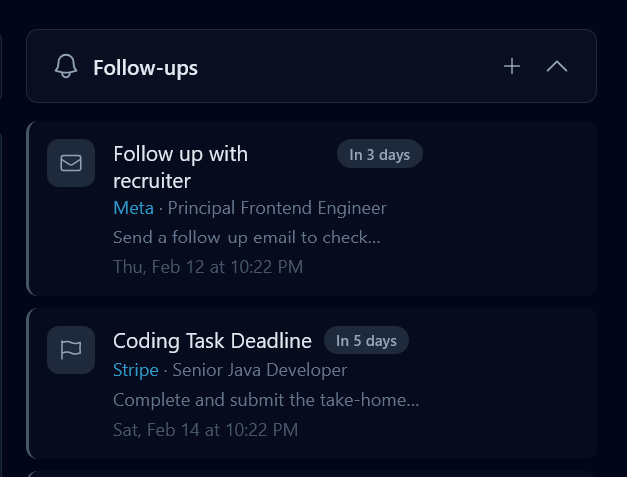
A useful workflow is to save the application, add the next action, check the latest correspondence when the reminder appears, and then mark the task complete or change its date. JobTrackr's follow-up reminders help organize these actions; they do not send the example messages on your behalf.
If you use an automatic ghosting status, treat it as a bookkeeping label based on elapsed time, not evidence about the employer's intentions. Review the record before deciding whether to contact someone again.
Keep the wider search manageable
During your weekly job-search review, separate opportunities awaiting an employer from work you can do now. Prepare for scheduled interviews, research suitable roles and update your notes. The interview-tracking guide helps you preserve timelines and next steps before communication becomes unclear.
The aim is to spend less effort reconstructing what happened and more effort on useful next actions. It is reasonable to feel disappointed by silence; a tracking system can reduce administrative uncertainty without explaining every hiring decision.
Start tracking your applications for free
Free includes 10 applications, including archived ones, one resume analysis and one interview quiz. See the plan comparison for Pro features.